Independent research · verified 2026-09-12
Types of Dock Levelers: The Three ANSI Classes, and What the Specs Actually Say
What are the key facts about types of dock levelers?
1. Two documented capacity pairs are 2:1—not a universal load rule. Rite-Hite’s RHE specification pairs its 40K designation with a 20,000 lb dynamically rated load; Poweramp’s VS sheet pairs 50,000 CIR with 25,000 lb dynamic capacity. These are document entries, not inspected nameplates. Source: Rite-Hite RHE rev. 12/15/2011; Poweramp VS 08/2025; verified September 12, 2026. 28 16
2. The RHE rating states 3 mph and a grade of 10% or less. That condition belongs to Rite-Hite’s 2011 RHE architectural specification; it is not a verified rating condition for every dock leveler. Source: Rite-Hite RHE, §1.2; verified September 12, 2026. 28
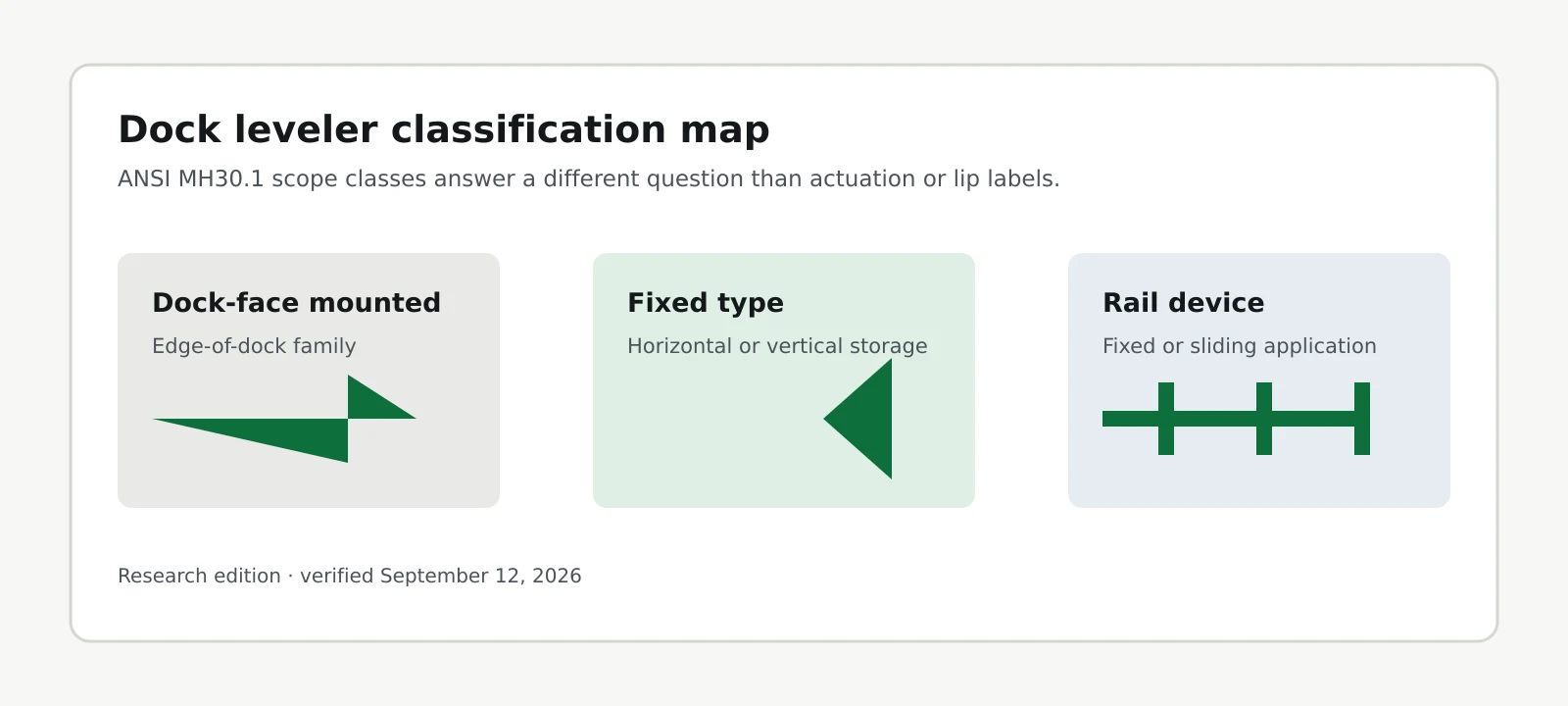
3. ANSI MH30.1 distinguishes three built-in device classes. Dock-face mounted, fixed and rail are the classes in the published 2015 scope; rail divides into fixed and sliding. MHI’s 2022 scope summary retains those categories. Source: ANSI MH30.1-2015 §1.2; MHI / LODEM 2022 scope summary; verified September 12, 2026. 1 3
4. Three operating-system labels are not the three scope classes. Mechanical, hydraulic and air-powered describe actuation; MH30.1’s scope categories describe installation or rail application. Both vocabularies are useful when kept separate. Source: MHI / LODEM; Kelley model documentation; verified September 12, 2026. 3 41
5. One leveler can carry three labels simultaneously. Nordock’s NVTL is hydraulic, vertical-storing and telescoping-lip. The labels describe different attributes of the same documented model. Source: Nordock NVTL product documentation; verified September 12, 2026. 38
6. One automatic mechanical example requires no electrical power. Rite-Hite’s FA-1600 uses truck activation and a fixed lip; “automatic” does not establish an electrical or hydraulic lifting system. Source: Rite-Hite FA-1600 product documentation; verified September 12, 2026. 29
7. Two storage arrangements share the fixed class. ANSI MH30.1-2015 §1.2(b) includes both horizontal-storing and vertical-storing devices in its fixed-type definition. Source: ANSI MH30.1-2015; MHI / LODEM 2022 scope summary; verified September 12, 2026. 1 3
8. OSHA explicitly includes dock levelers within “dockboards.” The definition in 29 CFR 1910.21(b) also includes bridge plates and dock plates; the regulatory umbrella is broader than the industry’s product labels. Source: eCFR, 29 CFR 1910.21(b); verified September 12, 2026. 6
9. The run-off exception requires an employer demonstration. Under 29 CFR 1910.26(b)(2), the employer must demonstrate that transfer vehicles have no hazard of running off the dockboard edge; pit installation alone is not an automatic exemption. Source: eCFR, 29 CFR 1910.26(b)(2); LODEM guidance; verified September 12, 2026. 7 4
10. LODEM illustrates an approximately 3-inch projection above a flush-stored pit leveler. That is its discussion of hypothetical side guards and cross traffic, not a universal required guard height or a reason to remove installed guards. Source: LODEM dockboard compliance guidance; verified September 12, 2026. 4
11. Two selected models show a fourfold difference in total published travel. Rite-Hite’s RHE has 3 inches above and below dock, or 6 inches total; Poweramp’s PR has 12 inches each way, or 24 inches total. The comparison is model-specific. Source: Rite-Hite RHE rev. 12/15/2011; Poweramp PR 1/2026; verified September 12, 2026. 28 17
12. Edge-of-dock range differs within the class. The reviewed RHE specification gives ±3 inches; NOVA’s hydraulic edge-of-dock and Blue Giant’s MD-CH give ±5 inches. Blue Giant says its optional 17-inch lip reduces working range by 2 inches. Source: Rite-Hite, NOVA and Blue Giant manufacturer documents; verified September 12, 2026. 28 27 35
13. Published standard lip lengths include 15, 16, 18 and 20 inches. Examples are NOVA hydraulic edge-of-dock at 15 inches, Poweramp AP at 16, PR at 18 for its 60K/80K/120K CIR options, and RCR railcar ramps at 20. These are selected specifications, not market frequencies. Source: NOVA and Poweramp model documentation; verified September 12, 2026. 27 19 17 23
14. At 45,000 CIR, two verified lip-thickness figures differ. NOVA’s NMS lists 5/8 inch and Poweramp’s VS lists 3/4 inch. The reviewed DLM ESM manual does not establish a lip thickness; thickness alone is not a strength ranking. Source: NOVA NMS; Poweramp VS 08/2025; DLM ESM February 2025; verified September 12, 2026. 26 16 25
15. Warranty terms cover different things: 1-year base and up to a 20-year hinge term. Blue Giant MD-CH lists one year parts and labor; Poweramp VS lists one year base plus four additional years for structural/hydraulic coverage; Nordock NVTL lists 10-year structural, 5-year hydraulic and 20-year hinge terms under specified guidelines. Source: Blue Giant, Poweramp and Nordock warranty descriptions; verified September 12, 2026. 35 16 38
16. Two reviewed Poweramp sheets still cite withdrawn CS202-56. The LHP sheet dated 11/2021 and HM sheet dated 6/2022 include that reference. The reviewed PR 1/2026 and VH 10/2022 sheets do not; NIST lists CS 202-56 as withdrawn. Source: Poweramp LHP, HM, PR and VH sheets; NIST withdrawn-standards table; verified September 12, 2026. 21 22 17 20 11
The strongest finding above is a comparison of published figures, not an instruction to halve a capacity label. The rest of this reference separates the classification words from the operating limits and keeps the original source beside each consequential number.
By Elkhart Dock Door Repair
Research edition: September 12, 2026 · Last verified: September 12, 2026
Elkhart Dock Door Repair Research is the independent research and reference section of elkhartdockdoorrepair.com.
Lists of dock leveler types can mix operating systems, storage positions and lip designs. The published ANSI MH30.1 scope instead distinguishes three built-in device classes. Hydraulic, mechanical and air-powered remain useful operating-system labels; they simply answer a different question. One unit can be hydraulic, vertical-storing and telescoping-lip at once. 1 3 38
There is a second distinction underneath: a model’s published capacity designation and its stated dynamically rated load need not be the same number. The RHE and VS documents below publish both; their selected pairs are 2:1. Neither that arithmetic nor the type label establishes a safe load for a particular installation. 28 16 7
What are the types of dock levelers?
A dock leveler bridges the gap or height difference between a loading dock and a transport vehicle. The published ANSI MH30.1 scope distinguishes dock-face mounted, fixed and rail devices; its fixed class includes horizontal and vertical storage, while rail devices can be fixed or sliding. Mechanical, hydraulic and air-powered describe the operating system, not these three scope classes. 1 3 6
That is a different classification from an operating-system list, not proof that every other use of the word “type” is wrong. The distinction changes how you read a product page: first identify the class, then record the operating system and the model-specific arrangement.
| ANSI type | Clause in 2015 scope | Scope description, paraphrased | Common trade name | Documented arrangement—not a universal installation rule |
|---|---|---|---|---|
| Dock-face mounted | §1.2(a) | Permanently attached at the dock face; also called edge-of-dock. | Edge-of-dock leveler, EOD | A dock-face family. Recessed-pit options are listed for some Kelley EOD models. |
| Fixed type | §1.2(b) | Attached to the dock structure, generally with assistance for positioning against the vehicle; includes horizontal and vertical storage. | Pit leveler, recessed leveler, vertical-storing leveler | Reviewed examples include pit-installed units that store horizontally or vertically. A concrete pit is not the entire definition. |
| Rail dock leveling device—fixed | §1.2(c)(i) | Stationary dock attachment, either at the face or recessed, for rail service. | Rail dock leveler, car ramp | A rail application with a fixed mounting position; reach is model-specific. |
| Rail dock leveling device—sliding | §1.2(c)(ii) | Dock-face mounting that permits sideways travel parallel to the face. | Sliding rail leveler | Lateral positioning permits alignment along the dock face. |
Source: ANSI MH30.1-2015, §1.2, and MHI / LODEM’s published MH30.1-2022 scope summary; Kelley KM/KH installation options. Verified September 12, 2026. Clause labels refer to the 2015 text; table descriptions are paraphrases. 1 3 44 45
Two adjacent standards complete the picture, and knowing which one applies to a given device is half the battle:
- ANSI MH30.2 covers portable dock leveling devices — portable bridging equipment, rather than a built-in leveler. MHI defines two: dock boards, built for heavy material-handling loads, and dock plates, used for lighter hand-truck and foot traffic.
- ANSI MH30.3 covers vehicle restraining devices. These include devices that engage a vehicle’s rear impact guard or wheels. Vehicle restraints have their own standard and are not a dock-leveler class. 3 14
Why a list can reach six or eight
Because they can be sorting by different things. Manufacturer catalogs use mechanical, hydraulic and air-powered labels, while other descriptions concern storage position or lip design. Combining those labels into a single exclusive list confuses what raises the deck with where it is installed or how its lip works. 41 29 38 40
The result is a list where "hydraulic" and "vertical-storing" and "telescoping-lip" sit as items one, four and seven. None of those three excludes the others. One product can be all three at once, and at least one is.
Why does one dock leveler fit three "type" labels at once?
Because the documents describe at least four separate attributes: what raises the deck, how the unit is installed, where the deck sits when stored, and how its lip is configured. Nordock’s NVTL is hydraulic, vertical-storing and telescoping-lip simultaneously. Those labels are not competing answers to the same question. 38 48
This is the framework the rest of the page uses. It is our editorial structure, built to fit the documented evidence. It is not an ANSI classification, and we do not present it as one.
| Axis | Question it answers | Labels found in the manufacturer documents reviewed | Does the label establish the other attributes? |
|---|---|---|---|
| Actuation | What raises the deck? | Mechanical, including spring-assisted and truck-activated examples; hydraulic; air-powered | No; the documented mechanism must be read at model level. |
| Installation / application | How is it attached, and is it a rail application? | Pit / recessed, dock-face mounted, fixed or sliding rail device | No; this overlaps the distinctions in MH30.1’s scope but is not a complete substitute for its definitions. |
| Storage position | Where does the deck sit when idle? | Horizontal; vertical | No; storage position is not the operating system. |
| Lip geometry | How is the lip configured? | Hinged, telescoping, fixed | No; geometry does not establish deck actuation. |
Source: Elkhart Dock Door Repair Research editorial framework, derived from the manufacturer documents linked in Table 3. Verified September 12, 2026. Separate attributes do not mean every theoretical combination is commercially available.
A fifth attribute sits underneath and is easy to miss: lip activation is recorded separately from deck actuation. What lifts the deck does not tell you what pushes the lip out. Rite-Hite’s RHA-4000 uses an air-tower lift with a mechanically extended lip. 31
Table 3: Manufacturer evidence — 13 model families, four brands
One row is one named model family as documented by its manufacturer. It is not one installed machine, one sale, or one independent "type." Blank means the document we read did not establish that field — it does not mean the feature is absent.
| Brand | Model family | Actuation | Installation as documented | Storage | Lip geometry | Verified detail | Tier |
|---|---|---|---|---|---|---|---|
| Kelley | CM | Mechanical | Pit-mounted | — | — (automatic lip extension) | Nine model sizes listed, 6 ft × 6 ft to 7 ft × 10 ft 46 41 | ★ |
| Kelley | aFX | Air | Pit interface documented | — | — | 120 V single-phase listed; 240 V single-phase optional 42 | ★ |
| Kelley | KM | Mechanical | Edge-of-dock family; recessed-pit option | — | Hinged | Manual activation; spring-assisted lip hinge 44 | ★ |
| Kelley | KA | Air | Edge-of-dock family | — | — | Low-pressure air-bag lifting system 43 | ★ |
| Kelley | KH | Hydraulic | Edge-of-dock family; recessed-pit option | — | Hinged | Hydraulic lifting; lug-style lip hinge 45 | ★ |
| Rite-Hite | RHM-4000 | Mechanical | Pit interface documented | — | — | Pull-chain activation 30 | ★ |
| Rite-Hite | RHA-4000 | Air | Pit interface documented | — | — (mechanical lip extension) | Air-tower lift with mechanically extended lip 31 | ★ |
| Rite-Hite | RHH-4000 | Hydraulic | Pit interface documented | — | Hinged | Front hinge between deck and lip 32 | ★ |
| Rite-Hite | RHV-4100 | Hydraulic | Pit interface documented | Vertical | — | Identified by the manufacturer as vertical-storing hydraulic 33 | ★ |
| Rite-Hite | FA-1600 | Mechanical | — | — | Fixed | Truck-activated; manufacturer states no electrical power is needed 29 | ★ |
| Pentalift | HDV | Hydraulic | — | Vertical | — | Manufacturer identifies the hydraulic vertical-storing combination 47 | ★ |
| Nordock | TLH | Hydraulic | Pit-mounted | Horizontal | Telescoping | Presented by the manufacturer as an alternative to vertical-storing levelers; horizontal storage follows the model-specific brochure; the web page contains conflicting storage wording 39 40 | ★ |
| Nordock | NVTL | Hydraulic | Pit seal specified | Vertical | Telescoping | Three labels on one model; capacities 30,000 / 40,000 / 50,000 lb; decks 7 ft × 6 ft and 7 ft × 8 ft; 15 in lip projection beyond a 4 in bumper 38 48 49 | ★ |
Source: Elkhart Dock Door Repair Research compilation of the model documents cited in each row and in the CSV. Verified September 12, 2026; dataset version 1.1. A source check verifies what the document says, not the physical performance of a unit. Verification tier: ★ = the recorded attribute was read directly in the cited primary document. No pending-verification rows are published in this edition. Unresolved attributes are excluded or explicitly identified as source conflicts, not upgraded to facts.
Dataset download: dock-leveler-model-families-2026-09-12.csv. Thirteen model-family records across four brands, with separate actuation, installation, storage, lip geometry and lip activation fields, source locators and conflict notes.
Dataset files and contents
These files contain the reference records behind the tables, including primary-source URLs, verification dates and the disclosed conflicts. They are the version 1.1 research edition, verified September 12, 2026; none is an installed-equipment database or an independent test report.
dock-leveler-capacity-decoder-2026-09-12.csv — Six explicitly published designation/load pairs, original rating terminology, stated conditions, source document, verification date and calculated ratio. No unsourced conversion row is included.
dock-leveler-model-families-2026-09-12.csv — Thirteen model-family records across four brands, with separate actuation, installation, storage, lip geometry and lip activation fields, source locators and conflict notes.
dock-leveler-published-spec-census-2026-09-12.csv — Sixteen selected specification records across seven brands, including the planning-guidance row, source versions, dimensions, capacity wording, range, lip, material and warranty fields.
dock-leveler-type-standard-crosswalk-2026-09-12.csv — Eight classification records mapping built-in, portable and restraint terminology to the relevant standard and regulatory context. Subclasses are not counted as extra top-level MH30.1 types.
dock-leveler-standards-lineage-2026-09-12.csv — Ten source-backed standards, rule and document-comparison records, including the positive LHP/HM and negative PR/VH CS202-56 checks.
Service-range CSV — the six model/configuration rows in Table 5, their stated above/below travel and calculated totals.
Warranty-scope CSV — the three Table 8 comparisons, keeping base, structural, hydraulic and hinge scopes separate.
Combined JSON — all seven tables, the source register, dataset version, field notes and reproducible coverage counts.
The four counterexamples that break the list
Each of these is a documented example showing why an attribute cannot be assumed from a different label. The examples establish the combination for the named family, not its prevalence in the market.
Edge-of-dock is not one operating system. Kelley documents a mechanical KM, an air-powered KA and a hydraulic KH, all inside its edge-of-dock family. The family label does not identify the actuation method. 44 43 45
Automatic does not mean electrically powered. Rite-Hite's FA mechanical leveler is raised by the truck itself: as the trailer backs in, it pushes the leveler bumpers rearward, the platform rises with that movement, and a fixed lip drops into the trailer bed. Rite-Hite states plainly that no electrical power is needed to operate it. So “automatic” describes activation, not proof of an electric or hydraulic lifting system. 29
Air-powered does not mean electricity-free. Kelley lists 120 V single-phase operation for its aFX air-powered leveler, with 240 V single-phase as an option. The air bellows raises the deck; the electrical supply is a separate question. 42
A telescoping lip does not require vertical storage. Nordock builds both: the vertical-storing NVTL and the horizontal-storing TLH, both with a telescoping lip. Nordock describes the TLH as an alternative to vertical-storing levelers. 38 40
One more that cuts the other way, and belongs here for honesty: an edge-of-dock family can include a pit option. Kelley lists a recessed-pit model for both its KM and KH edge-of-dock families. That is why this reference keeps the manufacturer’s installation options beside the broader family label. 44 45
What does a dock leveler's capacity rating actually mean?
The label’s meaning depends on the manufacturer’s stated rating basis. Poweramp’s VS sheet pairs Comparative Industry Rating (CIR) with a separate dynamic-capacity figure; Rite-Hite’s RHE specification pairs its 20K, 30K and 40K designations with dynamically rated loads and a stated crossing condition. The six selected pairs below are 2:1, but that is a documentary finding—not a universal conversion or a safe working-load calculation. 16 28
The distinction is easy to lose when a specification is reduced to one large number. Preserve the label, the manufacturer’s separate load figure, the document date and any stated conditions together.
| Manufacturer | Series | Published label | Manufacturer's own rated load | Ratio | Condition stated | Tier |
|---|---|---|---|---|---|---|
| Rite-Hite | RHE edge of dock | 20K | 10,000 lb | 2.00 | 3 mph, 10% grade or less | ★ |
| Rite-Hite | RHE edge of dock | 30K | 15,000 lb | 2.00 | 3 mph, 10% grade or less | ★ |
| Rite-Hite | RHE edge of dock | 40K (hydraulic power only) | 20,000 lb | 2.00 | 3 mph, 10% grade or less | ★ |
| Poweramp (Systems, LLC) | VS vertical storing | 40,000 CIR | 20,000 lb | 2.00 | not stated on the sheet | ★ |
| Poweramp (Systems, LLC) | VS vertical storing | 45,000 CIR | 22,500 lb | 2.00 | not stated on the sheet | ★ |
| Poweramp (Systems, LLC) | VS vertical storing | 50,000 CIR | 25,000 lb | 2.00 | not stated on the sheet | ★ |
Source: Rite-Hite RHE architectural specification rev. 12/15/2011, §1.2, and Poweramp VS specification sheet, VS SS 08/2025. Verified September 12, 2026. Ratio = numeric designation divided by the separately published load figure. The RHE document does not call its K designations CIR; neither document is evidence from an inspected nameplate. 28 16
Dataset download: dock-leveler-capacity-decoder-2026-09-12.csv. Six explicitly published designation/load pairs, original rating terminology, stated conditions, source document, verification date and calculated ratio. No unsourced conversion row is included.
What CIR does not tell you
The words Comparative Industry Rating identify an industry comparison term in the documents that use it. They do not, by themselves, determine whether a particular forklift, carrying a particular load, at a particular speed and grade, is safe on a particular deck. That determination needs the actual equipment documentation and application conditions, assessed by the manufacturer or a qualified professional; the ratios in Table 4 are not selection instructions. 16 7
Three things a CIR number will not answer:
- Whether manufacturers computed it the same way. The public standard material reviewed did not establish a complete CIR calculation method. ANSI’s Webstore listed the full MH30.1-2022 document at $69 when checked on September 12, 2026; it was not read in full. The accessible 2015 scope preview is not a substitute for its rating provisions. 1 2
- How much steel is in the load path. See Table 7. The two supported 45,000-CIR lip-thickness figures differ, while the DLM lip-thickness claim could not be substantiated. A plate thickness is not the total amount of steel or a strength comparison. 26 16 25
- What your operation actually does. OSHA's requirement at 29 CFR 1910.26(a) is that a dockboard be capable of supporting the maximum intended load, cross-referenced to 1910.22(b). A catalogue comparison alone does not establish that requirement for an operation. 7 9
A conversion without a matching manufacturer source is not part of this decoder. We have not adopted a distributor multiplier or extended the six illustrated ratios to other models. Other reviewed Poweramp sheets also publish dynamic-capacity/CIR pairs, so the RHE and VS documents are examples—not a claim that only two such documents exist. 19 20 21 22
A capacity conflict we chose not to resolve
Kelley’s KM and KH edge-of-dock pages contain inconsistent pound-and-kilogram capacity pairings. We re-opened both pages and excluded those capacity figures rather than pick a side or “repair” the conversion arithmetic. Recalculating a safety-related rating and assuming the underlying number is correct is exactly the kind of quiet error a reference page should not commit. The source problem is the pairing; this review does not establish which entry the manufacturer intended. 44 45
How much truck-bed height can each type actually reach?
Service range is the manufacturer’s published above- and below-dock travel for a particular configuration. The selected RHE specification gives ±3 inches and the PR sheet gives ±12 inches: 6 inches of total vertical travel against 24. That fourfold comparison applies to these documents, not every edge-of-dock versus every pit-mounted unit. 28 17
| Manufacturer | Series | ANSI type | Above dock | Below dock | Total range | Tier |
|---|---|---|---|---|---|---|
| Rite-Hite | RHE edge of dock | Dock-face mounted | 3 in | 3 in | 6 in | ★ |
| NOVA Technology | Hydraulic edge-of-dock | Dock-face mounted | 5 in | 5 in | 10 in | ★ |
| Blue Giant | MD-CH | Dock-face mounted | 5 in | 5 in | 10 in | ★ |
| Poweramp | VS, 5 ft and 6 ft units | Fixed, vertical storing | 10 in | 8 in | 18 in | ★ |
| Poweramp | VS, 8 ft units | Fixed, vertical storing | 12 in | 12 in | 24 in | ★ |
| Poweramp | PR | Fixed | 12 in | 12 in | 24 in | ★ |
Source: Rite-Hite RHE rev. 12/15/2011; NOVA hydraulic edge-of-dock product page; Blue Giant MD-CH 2024 brochure; Poweramp VS 08/2025 and PR 1/2026 sheets. Verified September 12, 2026. Total range is our addition of the two stated travel figures, not approval for a particular vehicle or load. Blue Giant’s standard-lip figure is shown; its optional 17-inch lip reduces working range by 2 inches. 28 27 35 16 17
Two things fall out of that table.
Edge-of-dock is not one number. Inside a single ANSI class, the published range runs from 6 inches total to 10. A writer who states "edge-of-dock levelers handle about 5 inches either way" is quoting one manufacturer and generalizing.
Deck length changes the answer within one product. Poweramp’s VS publishes 10 inches above and 8 below on its 5-foot and 6-foot decks, and 12 inches in both directions on the 8-foot deck. That is a documented configuration difference. For a given height difference, a longer horizontal run produces a shallower geometric slope; it does not follow that changing deck length alone makes a particular loading operation acceptable. 16 36
What do the published specifications show once you line them up?
The combined model-family and specification assets cover nine brands; the specification table below contains 16 records across seven brands, including one general planning record rather than a model family. This is a selected-document comparison, not a census of the market. Published lip lengths and thickness schedules differ across the documented configurations, and the source wording—not an assumed cross-brand convention—is preserved.
| Brand | Series / source edition | Actuation | Published widths | Published lengths | Published capacity wording | Standard lip length / projection distinction | Lip plate thickness by designation | Tier |
|---|---|---|---|---|---|---|---|---|
| Poweramp | Poweramp PR Series 17 | Hydraulic | 6 ft, 6 ft 6 in, 7 ft | 6, 8, 10, 12 ft | 30K, 35K, 40K, 45K, 50K, 60K, 80K, 120K CIR | 16 in at 30K/40K/45K/50K CIR; 18 in at 60K/80K/120K CIR | 5/8 in at 30K/35K/40K CIR; 3/4 in at 45K/50K/60K CIR; 1 in T1 smooth plate at 80K/120K CIR | ★ |
| Poweramp | Poweramp VS Series 16 | Hydraulic | 6 ft, 6 ft 6 in, 7 ft | 5, 6, 8 ft | 40K, 45K, 50K CIR | — (not recorded) | 5/8 in at 40K CIR; 3/4 in at 45K and 50K CIR | ★ |
| Poweramp | Poweramp AP Series 19 | Air (bellows) | 6 ft, 6 ft 6 in, 7 ft | 6, 8, 10 ft | 25K, 30K, 35K, 40K, 45K, 50K CIR | 16 in all capacities | 1/2 in at 25K CIR; 5/8 in at 30K/35K/40K CIR; 3/4 in at 45K and 50K CIR | ★ |
| Poweramp | Poweramp VH Series 20 | Hydraulic | 6 ft, 6 ft 6 in, 7 ft | 6, 8, 10, 12 ft | 25K to 80K CIR | 16 in at 25K/30K/35K/40K/45K/50K CIR; 18 in at 60K/80K CIR | 1/2 in at 25K; 5/8 in at 30K/35K/40K; 3/4 in at 45K/50K/60K; 1 in T1 smooth plate at 80K CIR | ★ |
| Poweramp | Poweramp LHP Series 21 | Hydraulic | 6 ft, 6 ft 6 in, 7 ft | 6, 8 ft | 25K, 35K, 40K CIR | 16 in all capacities | 1/2 in at 25K CIR; 5/8 in at 35K and 40K CIR | ★ |
| Poweramp | Poweramp HM Series 22 | Mechanical (spring) | 6 ft, 6 ft 6 in, 7 ft | 6, 8, 10 ft | 30K, 35K, 40K, 45K, 50K CIR | 16 in all capacities | 5/8 in at 30K/35K/40K; 3/4 in at 45K/50K CIR | ★ |
| Poweramp | Poweramp RCR Series 23 | Hydraulic | — (not recorded) | — (not recorded) | 40K, 50K, 60K CIR | 20 in standard; 16 in and 18 in options | 5/8 in at 40K; 3/4 in at 50K/60K CIR | ★ |
| McGuire | McGuire CentraAir (CA) 24 | Air (automotive-grade bellows, plant air) | 6 ft, 6 ft 6 in, 7 ft | 6, 8, 10 ft | Source conflict: cover/order form lists 25K/30K/35K/40K/45K/50K CIR; descriptive text and product page list 25K/30K/35K/40K/45K/55K CIR | 16 in in the reviewed specification | 1/2 in at 25K; 5/8 in at 30K/35K/40K; 3/4 in at 45K/55K as stated; upper-designation conflict retained | ★ |
| DLM | DLM ESM Series 25 | Mechanical (spring) | 6, 7 ft | 6, 8 ft | 35K, 45K CIR | Not established in reviewed manual | Not established in reviewed manual | ★ |
| NOVA Technology | NMS Mechanical 26 | Mechanical (spring) | — (not recorded) | — (not recorded) | 25K, 30K, 35K, 40K, 45K, 55K CIR | 16 in all capacities | 1/2 in at 25K CIR; 5/8 in at 30K/35K/40K/45K/55K CIR | ★ |
| NOVA Technology | Hydraulic Edge-of-Dock 27 | Hydraulic | — (not recorded) | — (not recorded) | 20K, 25K, 30K, 35K CIR | 15 in | Tread plate (platform and lip): 3/8 in at 20K and 25K CIR; 7/16 in at 30K CIR; 1/2 in at 35K CIR | ★ |
| Rite-Hite | RHE Edge of Dock 28 | Mechanical or hydraulic | 66, 72, 78, 84 in | — (not recorded) | 20K, 30K, 40K (40K hydraulic only) | Not recorded; projection: 12 in standard; 14 in optional | — (not recorded) | ★ |
| Blue Giant | MD-CH Series 35 | Hydraulic | 72, 78 in | 27 in nominal deck length | 30,000 lb, as labeled in brochure | 15 in standard; 17 in optional | — (not recorded) | ★ |
| Blue Giant | VL Series 37 | Electro-hydraulic | 72, 78, 83 in actual deck widths | 72, 96 in deck lengths; text says includes 20 in lip | 30,000 to 45,000 lb | Source conflict: dimension description includes 20 in lip; operating paragraphs refer to 16 in lip | — (not recorded) | ★ |
| Blue Giant | Dock leveler line (planning data) 36 | Various | 6 ft, 6 ft 6 in, 7 ft | 6, 8, 10, 12 ft | — (not recorded) | 16 in described as standard; 18, 20 and 24 in alternatives discussed | — (not recorded) | ★ |
| Nordock | NVTL 48 | Hydraulic | 7 ft | 6, 8 ft | 30,000, 40,000, 50,000 lb, as labeled | 20 in, per 2023 NVTL transmittal; projection: 15 in beyond a 4 in bumper, per NVTL brochure | — (not recorded) | ★ |
Source: primary model documents linked in each row and the source register; selected by Elkhart Dock Door Repair Research. Verified September 12, 2026. Seven brands are represented in these 16 records. Edition dates and full source URLs are retained in the CSV; the Blue Giant VL record is an explicitly labeled archive. Missing fields are not filled from neighboring models.
Dataset download: dock-leveler-published-spec-census-2026-09-12.csv. Sixteen selected specification records across seven brands, including the planning-guidance row, source versions, dimensions, capacity wording, range, lip, material and warranty fields.
Two document conflicts belong beside this table. McGuire’s CA 1/2026 cover/order form uses 50K as the upper designation, while the same sheet’s descriptive text and lip schedule, and its current product page, use 55K. The record preserves both without choosing an unsupported correction. Blue Giant’s archived VL specification says deck length includes a 20-inch lip but refers to a 16-inch lip in operating paragraphs; it is not converted into a single standard-lip claim. 24 50 37
Lengths also need their reference point. Rite-Hite’s RHE figure is lip projection beyond the bumper face, not the length of the lip plate. Nordock’s NVTL brochure gives 15 inches of projection beyond a 4-inch bumper; the separate 2023 transmittal lists a 20-inch standard lip. Those statements describe different measurements and are not in conflict merely because their numbers differ. The NVTL transmittal has adjacent NV and NVTL columns, so the selected model column is part of the source locator. 28 48 49
| Manufacturer / brand | Series | Published designation | Lip plate thickness supported by the reviewed source |
|---|---|---|---|
| Systems / DLM | ESM, mechanical | 45,000 CIR | Not established in the reviewed February 2025 manual. 25 |
| NOVA Technology | NMS, mechanical | 45,000 CIR | 5/8 in. 26 |
| Systems / Poweramp | VS, vertical-storing, hydraulic | 45,000 CIR | 3/4 in. 16 |
Source: DLM ESM owner’s/user’s manual, February 2025; NOVA NMS product documentation; Poweramp VS specification sheet, 08/2025. Verified September 12, 2026. The excluded DLM thickness is not treated as zero or inferred from unrelated dimensions. 25 26 16
Read that table carefully, because it is easy to misread. The supported thickness entries are 5/8 and 3/4 inch, not three values. The DLM row remains to make the evidence gap visible: its manual confirms the 45,000-CIR designation but does not establish a lip-plate thickness. Those two verified thicknesses neither prove equal load paths nor rank quality, strength or duty. What the comparison establishes is narrow and true: a shared CIR label does not establish identical lip thickness, and thickness alone does not establish interchangeability.
| Manufacturer | Series | Base warranty | Structural | Hydraulic | Hinge |
|---|---|---|---|---|---|
| Blue Giant | MD-CH | 1 year parts and labour from date of shipment | — | — | — |
| Poweramp | VS | 1 year on structural, hydraulic and electrical parts including freight and labour | +4 years extended (5 total) | +4 years extended (5 total) | — |
| Nordock | NVTL | 1 year performance guarantee from date of receipt | 10 years | 5 years | 20 years |
Source: Blue Giant MD-CH 2024 brochure; Poweramp VS 08/2025 specification sheet; Nordock NVTL product documentation and manufacturer brochure. Verified September 12, 2026. These are different coverage categories and start conditions, not an equivalent “structural warranty” range. Terms, exclusions and application requirements remain part of each manufacturer’s warranty. 35 16 38 48
One clause in that table is worth pulling out because it is easy to miss on a submittal. Poweramp states its warranty period begins at completion of installation or the sixtieth day after shipment, whichever is earlier. Under that clause, a delayed installation does not indefinitely delay the warranty start. 16
What does this data show, and what does it not show?
This page is a classification and specification reference assembled from published manufacturer documents, the published scope of an American National Standard, MHI’s current scope summaries, and federal rule text. It shows what the categories mean, which labels can apply to one machine, and what the published numbers actually say once they are lined up side by side.
It is not a survey, a test programme, or a market study. Here is the boundary, stated plainly:
| Question | Does this reference answer it? |
|---|---|
| What does each category label describe? | Yes |
| Which documented models combine which labels? | Yes |
| What do manufacturers publish for capacity, range, lip and warranty? | Yes, as published, with dates |
| Which type is most common in service anywhere? | No — we made no count of installed equipment |
| What does a dock leveler cost? | No — we collected no pricing |
| Which brand lasts longest or performs best? | No — we ran no tests and take no manufacturer performance claim as established |
| What capacity is safe for a specific forklift and load? | No — that is engineering work for a qualified professional |
| Is an existing installed unit safe or compliant? | No — a product-family document is not an inspection of a specific machine |
Source: Elkhart Dock Door Repair Research methodology and the source-defined limits of the tables above; verified September 12, 2026.
How was this reference and its dataset assembled?
This is a purposive review of published documents, not a representative equipment survey. The selected model roster was checked against primary sources and normalized into separate attributes; unsupported values were excluded. The original contribution is the joined, source-located comparison and its arithmetic—not ownership of manufacturer specifications.
What we collected. The type definitions come from §1.2 of ANSI MH30.1-2015, read from the standard’s published preview, which includes the Purpose and Scope section and foreword. MHI’s current summary supplies the corresponding 2022 scope context. The regulatory material comes from current 29 CFR 1910.21(b), 1910.22 and 1910.26; the 2016 final rule; the superseded 1910.30(a)(3) text in the 2002 CFR; NIST’s withdrawn-standards register; and official Indiana State Plan material. The specification evidence comes from manufacturer sheets, submittals, architectural specifications, manuals and product pages. 1 3 6 7 8 9 10 11 12 13
From where, and why these models. The selection is designed to illustrate class distinctions, overlapping labels, explicitly paired capacity figures and comparable specification fields. It is not a probability sample and does not establish which manufacturers dominate the market. The 2015 standard’s foreword lists seven contributing companies, but that historical list is not treated as a current market census or as evidence of current market representation. MHI’s current member description identifies Poweramp, McGuire and DLM as Systems brands; they remain separate brand labels in this comparison, not three independent manufacturers. Nordock’s paired horizontal- and vertical-storing telescoping-lip examples are included because they directly test the classification framework. 1 5 38 40
On what dates. The verification pass was completed on September 12, 2026. That is the research snapshot, not a publication date for the underlying material and not a claim that every document describes equipment first offered in 2026. Document codes are recorded separately: for example, RHE rev. 12/15/2011, VS 08/2025, RCR 10/2025, PR 1/2026 and CA 1/2026. A year or month embedded in a URL is not automatically a revision date. The undated Blue Giant VL specification is explicitly an archived manufacturer-authored document hosted by MCF, not presented as current Blue Giant V literature.
How we processed it. One row in the model-family crosswalk represents one named model family. The specification census separately contains model records and one Blue Giant planning-guidance record; that guidance is not converted into a fictional model. Only explicitly supported attributes are entered as values. Deck actuation, lip activation, installation, storage and geometry remain separate fields. Numerical designations are retained with their original label—CIR, K designation or published pounds—rather than normalized into a supposedly equivalent operating capacity. Every derived ratio and total is identified as arithmetic on published entries.
What a missing cell means. “Not recorded” means that this review did not establish the value from the cited source material. “Not established” identifies a field whose proposed value did not survive verification. “Source conflict” means incompatible statements remain in the cited primary material. None means zero, no feature, an option that cannot exist, or a license to fill the field from another product. A column labeled lip length is not silently populated with projection beyond a bumper.
Verification tiers, and what they mean. ★ means the stated attribute was read directly in the cited primary document. Manufacturer-authored archival material is labeled as archival even when its text was read directly. No ● pending-verification records are published as established facts in this edition. A check verifies that the document makes the statement; it does not turn a manufacturer’s claim into an independent physical test, certification audit or inspection of installed equipment.
Where sources conflict, we say so. Kelley’s inconsistent capacity conversions are excluded. TLH storage follows the model-specific horizontal-storing brochure, with the conflicting web paragraph disclosed. McGuire’s current CA sheet contains 50K and 55K upper-designation wording in different places; both remain attributed rather than averaged or selected without authority. Blue Giant’s archived VL document includes a 20-inch lip in one dimension statement and 16-inch references in its operating text, so no single standard lip length is inferred from that document. 44 45 39 40 24 50 37
How to reproduce the coverage counts. Count unique record_id values in the model-family CSV to obtain 13 families, then unique brand values to obtain four brands. Count the specification CSV’s row_id values to obtain 16 records, including the general planning row; its distinct brand values total seven. The union of brand names across those two files totals nine. These are publication-coverage counts, not installed-base, sales or market-share statistics.
How to reproduce the calculations. In the capacity decoder, divide the numeric portion of the source designation by its separately stated load: for example, 50,000 ÷ 25,000 = 2.00. In the service-range table, add stated upward and downward travel: 12 + 12 = 24 inches. In the Indiana paragraph, multiply FRED’s 33.42563 thousand-person observation by 1,000 and round to the nearest hundred to obtain approximately 33,400. The employment observation is an externally produced seasonally adjusted estimate; it is not a physical count made by this project. 15 16 17
How the files relate to the page. The CSVs preserve source URLs, document versions, verification dates and explicit conflict notes. The combined JSON contains the same records plus the service-range and warranty tables. The on-page specification table and downloadable specification records are generated from the same data, so a value is not corrected in the article while a contradictory value remains in a download. Dataset version 1.1 records the verified compilation and documented corrections; it does not claim a new field survey.
Does OSHA call these dock levelers?
Yes—OSHA explicitly includes dock levelers within its broader dockboard definition. In 29 CFR 1910.21(b), that umbrella includes portable or fixed bridging devices, including bridge plates, dock plates and dock levelers. The industry standards distinguish built-in devices under MH30.1 from portable dock boards and plates under MH30.2; OSHA’s broader terminology does not itself create an exemption or a contradiction. 6 3
The rule itself is short, but its qualifiers matter. Under 29 CFR 1910.26(a), dockboards must support the maximum intended load. Paragraph (b)(1) addresses prevention of transfer vehicles running off the edge for dockboards first put into service on or after January 17, 2017, subject to the employer-demonstration exception in (b)(2). Paragraph (c) requires portable dockboards to be secured against displacement; where securing is infeasible, sufficient contact must prevent them moving out of a safe position. Paragraph (d) requires measures preventing the transport vehicle from moving while employees are on the dockboard. Paragraph (e) requires handholds or other means permitting safe portable-dockboard handling. These are regulatory requirements, not equipment-operating instructions. 7
The run-off guard problem
Read 1910.26(b)(1) alongside OSHA’s definition and the application question becomes clear: how does the particular dockboard prevent a transfer vehicle running off its edge? MHI describes portable dock boards with side members that stiffen the board and serve as run-off curbs. A pit-mounted leveler can present a different arrangement, but “levelers do not have guards” is not a sound general rule. 7 3 16
LODEM published guidance on this question. Its discussion concerns the illustrated flush-storing pit-leveler arrangement, not every leveler configuration and not a universal instruction to omit guards. MHI lists the guidance with an October 28, 2020 publication date; the subject is the rule effective in 2017. Its stated concerns are specific: 4 14
- The hypothetical side run-off guards in LODEM’s flush-stored pit-leveler illustration would project roughly 3 inches above the dock floor when the leveler is parked flush, creating the trip hazard described in the guidance. 4
- It would interfere with forklift wheels and tines during loading, potentially stopping a truck abruptly or deflecting a load. 4
- The guidance also discusses docks designed for cross traffic — forklifts driving across a parked leveler, sideways, from one bay to the next. Side guards would block that in the illustrated arrangement. 4
LODEM discusses 1910.26(b)(2) as a route where an employer can demonstrate that no run-off hazard exists. Its example considers containment provided by pit walls and door jambs in particular operating positions. That is an industry explanation of an application-specific argument—not an OSHA ruling that any pit, wall or jamb automatically satisfies the exception. The actual geometry, operating positions and hazards still determine whether the employer can make the required demonstration. 4 7
Two documented facts complicate the neat version of that story, and both belong on the record.
Some levelers do have run-off guards. Poweramp’s VS specification states that 3-inch-high run-off guards are standard on all its platforms. That documented vertical-storing example is enough to rule out a blanket claim that dock levelers do not have side guards; the equipment arrangement still matters. 16
A front-edge barrier is a different feature from side run-off guards. Rite-Hite’s current Safe-T-Lip material describes a barrier lip intended to address vacant-dock drop-off. Its position and purpose differ from the side run-off guards discussed above; the manufacturer’s feature description does not establish compliance for every installation. The barrier-lip example belongs here because it shows why the position and purpose of a guard must remain explicit. 34 32
This section is educational and regulatory. It describes what the rules say and what qualified professionals handle. Determining whether any specific dock, leveler or operation satisfies 1910.26 is work for a qualified safety professional against the actual installation, and the issuing agency is the authority on its own rule.
Which standards actually govern dock levelers?
MH30.1, MH30.2 and MH30.3 address built-in dock leveling devices, portable dock leveling devices and vehicle restraints, respectively; 29 CFR 1910.26 supplies the federal dockboard requirements discussed here. The historical chain also includes the withdrawn MH14.1 predecessor and withdrawn Commercial Standard CS 202-56. A standard listed in a submittal, the current edition of that standard and an enforceable workplace rule are three different things. 1 3 7 11
| Standard or rule | Year / edition | Status as of September 12, 2026 | What it covers |
|---|---|---|---|
| ANSI/ASME MH14.1 | 1984, with addenda 1a-1985 and 1b-1986 | Withdrawn; withdrawal approved September 18, 1989 | Predecessor dock leveling device standard |
| ANSI MH30.1 | First approved December 16, 1993; revised 2000, 2007, 2015 (approved August 11, 2015), 2022 | Current edition MH30.1-2022 | Performance and testing requirements for built-in dock leveling devices |
| ANSI MH30.2 | 2022 edition; revises 2015 | Current edition MH30.2-2022 | Portable dock leveling devices — dock boards and dock plates |
| ANSI MH30.3 | 2022 edition; revises 2015 | Current edition MH30.3-2022 | Vehicle restraining devices — not levelers |
| Commercial Standard CS 202-56 | 1956; former OSHA rule refers to a 1961 version | Withdrawn — listed on NIST's withdrawn Commercial Standards table | Industrial Lifts and Hinged Loading Ramps |
| 29 CFR 1910.30(a)(3) | Pre-2017 | Superseded | Required powered dockboards to be built per CS202-56 (1961) |
| 29 CFR 1910.26 | Effective January 17, 2017 | Current | Dockboards, as a standalone section, referencing no outside design standard |
Source: ANSI MH30.1-2015 foreword and ANSI’s 2022 listing; MHI / LODEM current scope summaries; NIST withdrawn-standards register; historical CFR text and the 2016 final rule on GovInfo; current eCFR. Verified September 12, 2026. A page-update date is not a standard-withdrawal date. 1 2 3 11 10 8 7
The standard that outlived its own withdrawal
Here is the paper trail: the historical standard, its former incorporation in OSHA’s rule, the rule revision, NIST’s withdrawal listing and manufacturer documents that still retain the reference. Those sources need to be distinguished rather than collapsed into a claim that every current specification cites an obsolete requirement.
NIST’s register identifies Commercial Standard CS 202-56, “Industrial Lifts and Hinged Loading Ramps,” with a 1956 year. The historical federal rule incorporated CS202-56 (1961): former 29 CFR 1910.30(a)(3) required powered dockboards to be designed and constructed in accordance with that document. The 1956 identifier and the former rule’s 1961 parenthesis are retained as published; neither is silently converted into the other. 11 10
The walking-working surfaces final rule was published at 81 FR 82494 on November 18, 2016 and became effective January 17, 2017. Its dockboard discussion expressly removes the former CS202-56 incorporation. Dockboards received a standalone 29 CFR 1910.26; that section does not incorporate an outside design standard by reference. The removal is a change in the rule’s text, not a finding about the safety of equipment built under an older specification. 8 7
Meanwhile, NIST lists CS 202-56 among withdrawn Department of Commerce Commercial Standards. The register establishes that status; its web-page update date does not establish when withdrawal occurred. 11
And yet: Poweramp’s LHP sheet dated 11/2021 and HM sheet dated 6/2022 still state conformance to CS-202-56 alongside their other references. The distinction matters: the PR sheet coded 1/2026 and VH sheet coded 10/2022 reviewed in this pass do not contain that citation. The evidence supports a claim about two identified documents, not every current Poweramp sheet or the entire industry. 21 22 17 20
The same distinction applies when a manufacturer’s sheet is carried into an institutional specification. The exact standard number, edition and incorporation language need to stay attached to the quoted requirement. A historical reference is evidence of what that document required; it is not, without the current governing documents, a statement about what every present-day project must satisfy. The manufacturer sheets and federal records above establish that document history; they do not establish the governing requirements for an individual project.
What this is, and what it is not. Withdrawal alone does not determine whether a product or installation is compliant, safe or unsafe. Nor does a manufacturer’s statement of conformance establish that a current workplace has satisfied all applicable requirements. This reference makes no product-compliance verdict. What the paper trail does show is that document references can differ by edition, giving a specifier a concrete reason to check the actual submittal rather than assume that every cited standard is current.
How does the federal dockboard rule reach an Indiana employer?
Indiana operates an OSHA-approved State Plan administered by IOSHA within the Indiana Department of Labor. IOSHA states that it has jurisdiction over most private- and public-sector work establishments and jobsites; 29 CFR 1952.17 expressly recognizes coverage exceptions. The enforcing authority therefore depends on the establishment and activity, rather than being “the state, never federal OSHA” in every case. 12 13
There is a jurisdiction distinction worth keeping separate from an equipment definition. A federal regulation supplies the national text cited in this reference, while State Plan coverage determines which agency ordinarily enforces workplace requirements at a particular Indiana establishment. A building permit, manufacturer’s standards statement and occupational-safety determination are not interchangeable documents. This page does not infer a dock-specific permit requirement, state enforcement date or automatic adoption timetable from a general agency overview.
This reference does not calculate an Indiana enforcement date from the federal effective date alone. Applying a state transition provision requires the relevant current legal text and adoption record, not a general agency summary. IOSHA’s own page and the federal State Plan description provide the jurisdictional starting points. The national dockboard section above remains a cited description of federal text, not a blanket legal conclusion for every Indiana workplace. 12 13
For scale in this corner of the state, the Elkhart–Goshen, Indiana metropolitan area had approximately 33,400 transportation-equipment manufacturing jobs in July 2026, using the seasonally adjusted series published by the Federal Reserve Bank of St. Louis. FRED reports 33.42563 thousand persons, updated August 21, 2026; the underlying data are from BLS, with seasonal adjustment performed by the St. Louis Fed. Multiplying by 1,000 and rounding to the nearest hundred produces the approximately 33,400 figure. This is a seasonally adjusted employment estimate, not a count of buildings, loading bays, businesses or dock levelers. 15
Equipment classifications do not become a local equipment inventory. We make no claim about how many dock levelers of any type are installed in Elkhart County, and we did not estimate that number from manufacturing employment or building activity. No installed-leveler inventory was identified in the official sources used for this page; that is a limit of this research, not proof that no such records exist anywhere.
Why do these distinctions matter in current documents?
The distinctions matter because documents available together can use different vocabularies, rating labels and standard editions. This review found overlapping classifications, model-specific capacity pairs and conflicting source entries—not evidence of a measured industry trend. Three examples show why the exact document matters.
The rule changed; the terminology still needs translating. The dockboard rule effective January 17, 2017 uses an umbrella definition that expressly includes dock levelers. MH30.1 covers built-in devices, while MH30.2 covers portable dock boards and plates. The 1910.26(b)(2) exception requires an employer’s demonstration about a hazard; it is not a categorical exemption created by choosing one of those industry labels. The LODEM guidance explains one possible application, not a universal workaround. 6 7 8 3 4
Vertical storage and telescoping lips expose the limits of a single list. A model such as Nordock’s NVTL is hydraulic, vertical-storing and telescoping-lip. Its TLH provides a horizontal-storing telescoping-lip counterexample. Those documented combinations are enough to show that the labels describe different attributes; no claim about when product lists were invented, which design came first or how the market has shifted is necessary. 38 40
Large designations make the rating basis important, not self-evident. Poweramp’s PR page and 1/2026 sheet list options up to 120,000 CIR. That figure is a published designation—not proof of a trend toward larger units and not a license to import the RHE/VS ratio into another model. In the same review, McGuire’s CA product page and specification sheet disagree between 50K and 55K upper designations. Both examples reward reading the actual source instead of repeating a headline number. 18 17 24 50
What are the limitations of this reference?
This reference verifies published wording and reproducible comparisons, not physical equipment performance or compliance. Its selection is purposive, its documents have different vintages and several source conflicts remain visible. We would rather name those limits than have a fact-checker discover an unsupported conclusion later.
The standard preview reviewed is from 2015, not 2022. The publicly available 2015 preview contains the scope and foreword used here; MHI’s current 2022 summary supports the continued three-class scope. The full MH30.1-2022 text was not reviewed. ANSI’s listing showed $69 when checked on September 12, 2026; that price is a listing-specific observation, not a claim that every publisher charges the same amount. Clause numbers in Table 1 refer to the 2015 text, and this page does not claim that all later technical requirements are unchanged. 1 2 3
The public material reviewed did not establish a complete CIR method. Manufacturer sheets spell out Comparative Industry Rating and sometimes pair it with dynamic-capacity figures. That supports transcription of those entries, not an assertion that this review has reproduced every manufacturer’s rating procedure. Failure to locate a free definition is not proof that none exists. A standard’s comparison objective is not, by itself, the missing formula.
The 2:1 finding is limited to the illustrated pairs. Table 4 contains six published pairs from RHE and VS documents. The 2011 RHE specification uses K designations rather than explicitly labeling them CIR. The VS sheet uses a Dynamic Capacity / CIR pairing. Other reviewed Poweramp sheets also contain such pairs, so these are not claimed to be the only examples available. No ratio here should be applied to an unverified model or used to calculate an operating limit. 28 16 19 20
An unsupported conversion remains excluded. No distributor-derived multiplier is published as manufacturer guidance or entered as a measurement in the capacity dataset. A number circulating elsewhere does not become evidence through repetition. The decoder contains only pairs explicitly supported by its named primary sources and arithmetic on those pairs.
Missing cells, options and unlike dimensions remain distinct. A blank is not a zero and “not recorded” is not a universal absence. Nominal widths and lengths are not certified pit dimensions. Lip length, extension beyond a deck, projection beyond a bumper and effective support on the vehicle bed are different measurements. The archived VL source’s 20-inch lip inclusion conflicts with 16-inch wording elsewhere in the same document; the table preserves that conflict rather than selecting a convenient standard value. 37
Source conflicts are recorded, not averaged away. Kelley’s KM/KH pound-and-kilogram capacity pairs are inconsistent, so those capacities are excluded. Nordock’s TLH main description and model brochure identify horizontal storage, while a web Construction paragraph refers to vertical storage. McGuire’s CA 1/2026 cover/order form lists 50K at the top, while its descriptive text, lip schedule and product page use 55K. These are conflicts within or between primary sources; this research does not know the manufacturers’ intended corrections. 44 45 39 40 24 50
Verification does not remove the difference between current and archived material. All published attributes marked ★ were read directly in primary documents. The Blue Giant VL source is an undated manufacturer-authored archive hosted by MCF; it is not asserted to be the current V model or current availability. The RHE document is explicitly a 2011 specification. A document remaining accessible online is evidence of its contents, not proof that its revision is the current orderable specification. 37 28 51
A verification date is not a guarantee that a specification remains unchanged. The date records when this review checked the source. It does not retroactively date an undated brochure, confirm that an installed unit matches it or extend a manufacturer warranty. Document-specific options, conditions, exclusions and later revisions still matter. A warranty summary does not establish the remaining coverage on a particular unit.
No demand, prevalence or trend study was conducted. Brand counts are counts of the names represented in these files, not counts of independent manufacturers or market shares. We did not measure how often a type is installed, how frequently a specification is selected or how purchasing preferences have changed. The Indiana employment estimate is contextual data from its named producer, not a proxy for local dock-leveler prevalence.
We measured nothing physical. No load tests, site visits, inspections, installed-base counts, transaction prices or reliability comparisons were performed. Manufacturer specifications are attributed as published specifications. No original claim is made about injury reduction, equipment lifespan, maintenance cost, comparative safety or which product is best.
What questions come up about dock leveler types?
The answers below keep class, operating system and model-specific figures separate. They use the same primary documents as the tables and do not add a universal selection rule where the source only establishes a particular configuration.
How many types of dock levelers are there?
It depends on the attribute being classified. The published MH30.1 scope identifies three built-in classes—dock-face mounted, fixed and rail—and divides rail devices into fixed and sliding arrangements. The model documents also use mechanical, hydraulic and air-powered for actuation; horizontal or vertical for storage; and hinged, telescoping or fixed for lip geometry. These are different vocabularies, not numbers to add into one exclusive total. A hydraulic vertical-storing telescoping-lip unit occupies one row in the evidence table, not three separate machines. 1 3 38
What is the difference between a dock leveler, a dockboard and a dock plate?
The industry vocabulary distinguishes built-in levelers under MH30.1 from portable dock boards and dock plates under MH30.2. MHI describes portable dock boards with supporting side members that also provide run-off curbs, while dock plates are intended for lighter hand-truck and foot traffic without those added supporting members. Under OSHA’s 29 CFR 1910.21(b), bridge plates, dock plates and dock levelers are all included within “dockboard.” That is three named devices discussed across two equipment standards, not three different equipment standards. 3 4 6
What does CIR mean on a dock leveler?
Comparative Industry Rating. The reviewed Poweramp sheets use that term for a capacity designation and, in several cases, list dynamic capacity separately. The VS sheet pairs 50,000 CIR with 25,000 lb dynamic capacity. Rite-Hite’s historical RHE sheet also contains 2:1 designation/load pairs, but it does not call its K designations CIR. A CIR label and a separately stated load must remain distinguishable; this reference does not supply a universal conversion formula. 16 19 20 28
How much weight can a dock leveler actually hold?
That depends on the particular equipment, the manufacturer’s rating basis and the loading conditions; the type name or a ratio from another model cannot establish it. The reviewed 2011 RHE specification states its dynamic ratings at 3 mph and a grade of 10% or less. OSHA’s 1910.26(a), cross-referencing 1910.22(b), requires support for the maximum intended load. Manufacturer documentation and a qualified assessment of the actual forklift, load, configuration and operation are needed; neither “use the headline number” nor “halve every nameplate” is an adequate rule. 28 7 9
What is the standard size of a dock leveler?
There is no single size established by this dataset. Reviewed Poweramp sheets list nominal widths of 6 ft, 6 ft 6 in and 7 ft; the VS sheet lists 5-, 6- and 8-ft lengths, while PR lists 6, 8, 10 and 12 ft. Blue Giant’s planning page lists 6-, 6½- and 7-ft widths and 6-, 8-, 10- and 12-ft lengths—not a 5-ft width. These are published options or planning dimensions, not a survey of what is most commonly installed. Actual deck and pit dimensions must remain model-specific. 16 17 36
How long is a dock leveler lip?
Examples in the reviewed sources include 16-inch standard lips on Poweramp AP, HM and LHP and on NOVA NMS. NOVA’s hydraulic edge-of-dock page specifies 15 inches; Poweramp’s RCR sheet specifies 20 inches; the PR sheet specifies 18 inches for its 60K, 80K and 120K CIR options. Blue Giant’s planning guidance describes 16 inches as standard and discusses other lengths. Lip length is not the same as projection beyond a bumper or effective support on a trailer bed, and the DLM ESM lip length was not established in this review. 19 22 21 26 27 23 17 36 25
What is an edge-of-dock leveler, and when is it not enough?
It is the family associated with the dock-face mounted class in MH30.1’s scope. The reviewed RHE document gives ±3 inches of service range; NOVA’s hydraulic edge-of-dock and Blue Giant’s standard-lip MD-CH give ±5 inches. Those limits differ, and selected Kelley EOD families also list recessed-pit options. Whether a particular arrangement can serve a vehicle depends on its documented configuration, geometry and loading conditions—not the family name alone. 1 28 27 35 44 45
Can an edge-of-dock leveler be air-powered?
Yes. Kelley’s KA is an air-powered edge-of-dock family using a low-pressure air-bag lifting system. Kelley also documents mechanical KM and hydraulic KH edge-of-dock families. The shared family label therefore does not specify one operating system, although that does not imply every conceivable operating system is available on every model. 43 44 45
Do air-powered dock levelers need electricity?
Answer that at model level. Kelley lists 120 V single-phase operation for its aFX air-powered leveler and a 240 V single-phase option. McGuire’s CA uses plant air or a dedicated compressor and offers different control arrangements, including pneumatic operation; its sheet also describes electrical control options. “Air-powered” identifies the lifting mechanism, not the complete electrical requirements of the installation or its compressed-air supply. 42 24 50
Can a mechanical dock leveler operate automatically?
Yes. Rite-Hite’s FA-1600 is described as a fully automatic mechanical, truck-activated leveler. The manufacturer explains that interaction with the bumpers raises the platform and places a fixed lip at the trailer, and states that no electrical power is required to operate the leveler. This is a description of the documented mechanism, not an operating procedure or a claim that every mechanical model works this way. 29
Is vertical-storing the same thing as hydraulic?
No. Vertical-storing describes where the deck rests when idle; hydraulic describes actuation. The vertical-storing examples in this dataset are documented as hydraulic, but a property of this selected roster is not a universal classification rule. MH30.1’s fixed class includes both horizontal- and vertical-storing devices, while model literature supplies the actual operating-system detail. 1 3 33 47 38
Can a telescoping-lip leveler store horizontally?
Yes. Nordock’s TLH literature identifies a horizontal-storing telescoping-lip leveler, while its NVTL documentation identifies a vertical-storing telescoping-lip model. The TLH brochure is the basis for the storage entry in this dataset. Conflicting vertical-storage language in the TLH web page’s Construction paragraph is retained as a source discrepancy rather than silently reconciled. 40 38 39
Is a dock leveler a dockboard under OSHA?
Yes. OSHA’s definition in 29 CFR 1910.21(b) explicitly includes dock levelers within dockboards, alongside bridge plates and dock plates. Section 1910.26 uses that umbrella term, with some provisions specifically addressing portable dockboards. Industry names remain useful for distinguishing equipment, but they do not remove a device from the regulatory definition. 6 7
Does OSHA require run-off guards on a dock leveler?
Section 1910.26(b)(1) requires dockboards first put into service on or after January 17, 2017 to be designed, constructed and maintained to prevent transfer vehicles running off the edge. Paragraph (b)(2) provides an exception where the employer demonstrates that no such hazard exists. LODEM discusses pit walls and door jambs in its illustrated pit-leveler arrangement; that is not a blanket exemption for every pit. Some documented levelers have side guards, including Poweramp VS. A qualified assessment and the enforcing agency’s requirements determine the specific application. 7 4 16
What ANSI standard covers dock levelers?
MH30.1 covers built-in dock leveling devices; the publisher listings checked identify the 2022 edition. MHI lists it as “Design, Testing, and Utilization of Dock Leveling Devices,” while ANSI’s Webstore listing uses “Performance and Testing Requirements for Dock Leveling Devices.” The identifier and edition are the reliable cross-reference. MH30.2 covers portable dock boards and plates, and MH30.3 covers vehicle restraining devices. This page’s detailed clause references are to the public 2015 scope, not an unread complete 2022 text. 1 2 3 14
What is a rail dock leveler?
It is a dock leveling device for a railcar application. The published MH30.1 scope distinguishes fixed rail devices, mounted at the dock face or in a pit, from sliding devices whose mounting permits lateral movement along the face. Poweramp’s RCR sheet supplies one model-specific example with a 20-inch standard lip. That dimension is not a universal rail-class requirement, and this dataset does not establish that every rail gap is larger than every trailer gap. 1 3 23
What are this page’s citation details?
The block below identifies the publication, page and dataset edition. It is a neutral attribution reference; the individual source entries retain the primary documents behind the compilation.
How to cite this page: attribution metadata
Publication: Elkhart Dock Door Repair Research
Page: Types of Dock Levelers: The Three ANSI Classes, and What the Specs Actually Say
URL: https://elkhartdockdoorrepair.com/research/types-of-dock-levelers/
Dataset: Dock leveler classification, capacity and specification dataset
Dataset version: 1.1
Research edition: September 12, 2026
Last verified: September 12, 2026
The compilation’s creator is Elkhart Dock Door Repair. Manufacturer specifications, standards and regulatory text remain attributed to their respective original publishers. The page’s verification date is separate from each source document’s revision date.
Which primary sources support the figures and definitions?
The source register identifies the original document or producer behind each material claim. Every entry was checked on September 12, 2026; source revision dates and archival status are stated separately, and no full-text standard review is implied by a publisher-listing citation.
Standards and standards bodies
1. ANSI MH30.1-2015, Performance and Testing Requirements for Dock Leveling Devices. Published preview; foreword, approval page and §1.2. The full 2022 text was not reviewed. Verified September 12, 2026.
https://webstore.ansi.org/preview-pages/MHIA/preview_ANSI+MH30.1-2015.pdf
2. ANSI MH30.1-2022, ANSI Webstore listing and document history. Publisher listing; 2022 edition, revision history and listed price. Not the full standard. Verified September 12, 2026.
https://webstore.ansi.org/standards/mhia/ansimh302022
3. MHI / LODEM, standards scope summaries. MH30.1-2022, MH30.2-2022 and MH30.3-2022 scope summaries. Verified September 12, 2026.
https://og.mhi.org/lodem
4. LODEM, Loading Dock Compliance Considerations with New OSHA Rule 29 CFR 1910.26. Industry interpretation, not an OSHA determination. MHI lists this publication with an October 28, 2020 date; it discusses the rule effective in 2017. Verified September 12, 2026.
https://og.mhi.org/downloads/industrygroups/lodem/lodem_osha_rule29.pdf
5. MHI, LODEM resource and member index. Current member descriptions and publication listings. Includes Systems and its Poweramp, McGuire and DLM brands. Verified September 12, 2026.
https://www.mhi.org/search?industryGroup=LODEM
Federal, Indiana and employment sources
6. 29 CFR 1910.21(b), dockboard and maximum intended load definitions. Current regulatory definitions. Verified September 12, 2026.
https://www.ecfr.gov/current/title-29/subtitle-B/chapter-XVII/part-1910/subpart-D/section-1910.21
7. 29 CFR 1910.26, Dockboards. Current text, paragraphs (a)–(e), including the exceptions in (b)(2) and (c). Verified September 12, 2026.
https://www.ecfr.gov/current/title-29/subtitle-B/chapter-XVII/part-1910/subpart-D/section-1910.26
8. OSHA, Walking-Working Surfaces and Personal Protective Equipment (Fall Protection Systems), final rule. 81 FR 82494; November 18, 2016; effective January 17, 2017. Dockboard discussion explains removal of the CS202-56 incorporation. Verified September 12, 2026.
https://www.govinfo.gov/content/pkg/FR-2016-11-18/html/2016-24557.htm
9. 29 CFR 1910.22, General requirements. Paragraph (b), loads; cross-referenced by §1910.26(a). Verified September 12, 2026.
https://www.ecfr.gov/current/title-29/subtitle-B/chapter-XVII/part-1910/subpart-D/section-1910.22
10. Former 29 CFR 1910.30, Other working surfaces. July 1, 2002 annual CFR edition; former (a)(3) incorporated CS202-56 (1961). Historical, not current law. Verified September 12, 2026.
https://www.govinfo.gov/content/pkg/CFR-2002-title29-vol5/html/CFR-2002-title29-vol5-sec1910-30.htm
11. NIST, Withdrawn DOC Commercial Standards (CS). Lists CS 202-56, Industrial Lifts and Hinged Loading Ramps, 1956. The page update is not a withdrawal date. Verified September 12, 2026.
https://www.nist.gov/standardsgov/withdrawn-doc-commercial-standards-cs
12. 29 CFR 1952.17, Indiana State Plan. State Plan approvals and coverage, including exceptions. Verified September 12, 2026.
https://www.ecfr.gov/current/title-29/subtitle-B/chapter-XVII/part-1952/subpart-A/section-1952.17
13. Indiana Department of Labor, IOSHA Home. Administering agency and jurisdiction over most private- and public-sector establishments and jobsites. Verified September 12, 2026.
https://www.in.gov/dol/iosha/iosha-home/
14. MHI, current standards and LODEM publication register. Publisher descriptions of the 2022 standards and their full titles; publication date assigned to the dockboard guidance. Verified September 12, 2026.
https://www.mhi.org/search?industryGroup=LODEM
15. Federal Reserve Bank of St. Louis, transportation equipment manufacturing employment in Elkhart–Goshen, Indiana. Series SMU18211403133600001SA; BLS underlying data, seasonally adjusted by the Federal Reserve Bank of St. Louis. July 2026: 33.42563 thousand persons; release updated August 21, 2026. Verified September 12, 2026.
https://fred.stlouisfed.org/series/SMU18211403133600001SA
Manufacturer documentation
16. Poweramp, VS Series specification sheet and submittal. Document code VS SS 08/2025; order form, construction, operation and warranty. Verified September 12, 2026.
https://www.poweramp.com/files/2025-09/VS%20Spec%20Sheet%2008-2025.pdf
17. Poweramp, PR Series specification sheet and submittal. Document code PR SS 1/2026; linked from the current PR product page. Does not cite CS202-56. Verified September 12, 2026.
https://www.poweramp.com/files/2026-06/PR%20Spec%20Sheet_0.pdf
18. Poweramp, PR Hydraulic Dock Leveler. Current product page and link to the PR specification sheet. Verified September 12, 2026.
https://www.poweramp.com/products/loading-dock-levelers/hydraulic-levelers/pr-hydraulic-dock-leveler
19. Poweramp, AP Series specification sheet and submittal. Document code AP SS 10/2022; specifications and dynamic-capacity/CIR pairs. Verified September 12, 2026.
https://www.poweramp.com/files/2022-10/AP%20Spec%20Sheet.pdf
20. Poweramp, VH Series specification sheet and submittal. Document code VH SS 10/2022; does not cite CS202-56. Verified September 12, 2026.
https://www.poweramp.com/files/2022-10/VH%20Spec%20Sheet.pdf
21. Poweramp, LHP Series specification sheet and submittal. Document code LHP SS 11/2021; cites CS202-56 in its description. Verified September 12, 2026.
https://www.poweramp.com/files/2021-11/LHP%20Spec%20Sheet.pdf
22. Poweramp, HM Series specification sheet and submittal. Document code HM SS 6/2022; cites CS202-56 in its description. Verified September 12, 2026.
https://www.poweramp.com/files/2022-06/HM%20Spec%20Sheet_0.pdf
23. Poweramp, RCR Series hydraulic railcar ramp specification sheet. Document code RCR SS 10/2025. Verified September 12, 2026.
https://www.poweramp.com/files/2025-12/RCR%20Spec%20Sheet%2010-2025.pdf
24. McGuire, CentraAir CA specification sheet and submittal. Document code CA SS 1/2026. Cover/order form gives a 50K upper designation; description/lip schedule gives 55K. Conflict retained. Verified September 12, 2026.
https://www.wbmcguire.com/files/2026-06/CA%20Spec%20Sheet_0.pdf
25. DLM, ESM Series owner’s/user’s manual. 4111-0033, February 2025; printed p.8, General Information. Supports widths, lengths and 35K/45K CIR; lip thickness was not established from this manual. Verified September 12, 2026.
https://www.dlmdocks.com/files/2025-02/D_ESM_4111-0033_Feb2025_0.pdf
26. NOVA Technology, NMS Mechanical Dock Leveler. Product specifications, deck/lip material, capacity designations, lip length and service range. Verified September 12, 2026.
https://www.novalocks.com/loading-dock-equipment/nms-mechanical-dock-leveler/
27. NOVA Technology, Hydraulic Edge-of-Dock Leveler. Product specifications, tread plate, lip length and service range. Verified September 12, 2026.
https://www.novalocks.com/loading-dock-equipment/hydraulic-edge-of-dock-leveler/
28. Rite-Hite, RHE Edge of Dock architectural specification. Revision 12/15/11; §1.1 service range, §1.2 load ratings, §1.3 widths and §1.4 lip projection. Historical specification, not a current universal rating rule. Verified September 12, 2026.
https://www.ritehite.com/en/am/resource-center/drawings-and-specifications/3ce892f04dad41aba7d9bbc6b7e3c315/rhe-arch-spec
29. Rite-Hite, FA-1600 Fully Automatic Mechanical Dock Leveler. Truck activation, fixed lip and no electrical power requirement. Verified September 12, 2026.
https://www.ritehite.com/en/am/products/loading-dock-levelers/mechanical-dock-levelers/fa-mechanical
30. Rite-Hite, RHM-4000 Mechanical Dock Leveler. Pull-chain activation and pit interface. Verified September 12, 2026.
https://www.ritehite.com/en/am/products/loading-dock-levelers/mechanical-dock-levelers/mechanical
31. Rite-Hite, RHA-4000 Air-Powered Dock Leveler. Air-tower lift and mechanical lip extension. Verified September 12, 2026.
https://www.ritehite.com/en/am/products/loading-dock-levelers/air-powered-dock-levelers/air-powered
32. Rite-Hite, RHH-4000 Hydraulic Dock Leveler. Hydraulic actuation, concrete-pit interface, deck/lip hinge and barrier-lip feature. Verified September 12, 2026.
https://www.ritehite.com/en/am/products/loading-dock-levelers/hydraulic-dock-levelers/rhh-hydraulic
33. Rite-Hite, RHV-4100 Vertical-Storing Dock Leveler. Hydraulic vertical storage and pit-interface descriptions. Verified September 12, 2026.
https://www.ritehite.com/en/am/products/loading-dock-levelers/vertical-storing-dock-levelers/rhv-vertical-storing
34. Rite-Hite, Safe-T-Lip. Manufacturer description of a front-edge barrier lip; distinct from side run-off guards. Verified September 12, 2026.
https://www.ritehite.com/en/am/products/loading-dock-levelers/dock-hazard-recognition/safe-t-lip
35. Blue Giant, MD-CH Series Hydraulic Model brochure. 2024 brochure; nominal sizes, 30,000 lb designation, standard/optional lips, range and warranty. Verified September 12, 2026.
https://www.bluegiant.com/getattachment/71a87fbe-7753-4eba-a998-e47ad6840a75/MD-CH_Series_Hydraulic_Model_Brochure_2024.pdf?ext=.pdf&lang=en-us
36. Blue Giant, Planning and Design: Leveler Width and Length. General planning guidance, not a model-specific submittal. Verified September 12, 2026.
https://www.bluegiant.com/en/architects/planning-and-design/leveler-width-and-length/
37. Blue Giant, VL vertical-storing specification, archived manufacturer-authored document. Undated specification hosted by MCF. It names Blue Giant Model VL and cites MH30.1-2007. Its 20-inch lip inclusion and 16-inch operating references conflict; they are not silently reconciled. Verified September 12, 2026.
https://mcf.ca/storage/dock-equipement/vl/en/specifications.pdf
38. Nordock, NVTL Vertical Dock Leveler with Telescoping Lip. Actuation, storage, lip geometry, pit interface and warranty. Verified September 12, 2026.
https://nordockinc.com/product/nordock-nvtl-vertical-dock-leveler-with-telescoping-lip/
39. Nordock, TLH Horizontal-Storing with Telescoping Lip. Heading/features identify horizontal storage; Construction contains conflicting vertical-storage wording. Verified September 12, 2026.
https://nordockinc.com/product/nordock-tlh-horizontal-storing-with-telescoping-lip/
40. Nordock, TLH Horizontal-Storing Dock Leveler literature. Undated model literature; storage and pit installation read directly. URL directory is not treated as a publication date. Verified September 12, 2026.
https://nordockinc.com/wp-content/uploads/2019/08/Model-TLH-%E2%80%93-TELESCOPING-LIP%E2%84%A2-%E2%80%93-Dock-Leveler-%E2%80%93-Literature-1.pdf
41. Kelley, Dock Levelers product index. Product-family classifications. Verified September 12, 2026.
https://www.kelleydocksolutions.com/products/dock-levelers
42. Kelley, aFX Air-Powered Dock Leveler. 120 V single-phase operation and optional 240 V single-phase supply. Verified September 12, 2026.
https://www.kelleydocksolutions.com/products/dock-levelers/air-powered-dock-levelers/afx-air-powered-dock-leveler
43. Kelley, KA Series Air-Powered Edge-of-Dock Leveler. Low-pressure air-bag lift. Verified September 12, 2026.
https://www.kelleydocksolutions.com/products/dock-levelers/edge-of-dock-levelers/ka-series-air-powered-edge-of-dock-leveler
44. Kelley, KM Series Mechanical Edge-of-Dock Leveler. Manual activation, spring-assisted hinge and recessed-pit option; inconsistent lb/kg capacity pairings excluded. Verified September 12, 2026.
https://www.kelleydocksolutions.com/products/dock-levelers/edge-of-dock-levelers/km-series-mechanical-edge-of-dock-leveler
45. Kelley, KH Series Hydraulic Edge-of-Dock Leveler. Hydraulic lift, lug-style hinge and recessed-pit option; inconsistent lb/kg capacity pairing excluded. Verified September 12, 2026.
https://www.kelleydocksolutions.com/products/dock-levelers/edge-of-dock-levelers/kh-series-hydraulic-edge-of-dock-leveler
46. Kelley, CM Series Mechanical Dock Leveler. Nine published model sizes and automatic lip extension. Verified September 12, 2026.
https://www.kelleydocksolutions.com/products/dock-levelers/mechanical-dock-levelers/cm-series-mechanical-dock-leveler
47. Pentalift, HDV Vertical-Storing Dock Leveler. Hydraulic vertical-storing classification. Verified September 12, 2026.
https://www.pentalift.com/solutions/hdv-vertical-storing-dock-leveler/
48. Nordock, NVTL model literature. Undated brochure; 30K/40K/50K lb designations, 7 × 6 and 7 × 8 ft decks, and lip projection 15 inches beyond a 4-inch bumper. Verified September 12, 2026.
https://nordockinc.com/wp-content/uploads/2019/08/Model-NVTL-%E2%80%93-Vertical-TELESCOPING-LIP%E2%84%A2-%E2%80%93-Dock-Leveler-%E2%80%93-Literature.pdf
49. Nordock, Vertical Dock Leveler Transmittal. Form marked 2023. NVTL is the right-hand column: 7 × 6 and 7 × 8 ft, 30K/40K/50K, 20-inch standard lip. NV is a separate left-hand column. Verified September 12, 2026.
https://nordockinc.com/wp-content/uploads/2019/08/Model-NVTL-%E2%80%93-VERTICAL-STORING-%E2%80%93-Dock-Leveler-%E2%80%93-Transmittal.pdf
50. McGuire, CentraAir CA Air-Powered Dock Leveler. Product page lists a 55K CIR option, unlike the 50K upper designation in the CA order form. Plant-air and control options. Verified September 12, 2026.
https://www.wbmcguire.com/products/loading-dock-levelers/air-powered-levelers/centraair-air-powered-dock-leveler
51. Blue Giant, document library. Issuer-hosted route to the MD-CH and current vertical-storing publications. The current V material is not substituted for the archived VL model. Verified September 12, 2026.
https://www.bluegiant.com/en/resources/document-library/
By Elkhart Dock Door Repair · Last verified: September 12, 2026.
Elkhart Dock Door Repair Research is the independent research and reference section of elkhartdockdoorrepair.com.